Sunday, October 24, 2010

YES, I am planning for next year ...

... and cutting back, taking inventories, cleaning up and covering. At the same time I have started my winter hobby again - listing vintage clothing, etc. on eBay and Etsy.

In my next post I will show some of the new plants I have ordered for next year.


Etsy
VintagefromVermont

Thursday, October 7, 2010

Fall Bulbs in Vermont - It's Time!

As a child growing up in Connecticut our spring gardens were full of flowering bulbs. My Dad concentrated on daffodils, narcissi and hyacinths. The latter have never done well for me in Vermont and I don't care for the over bearing fragrance anyway.


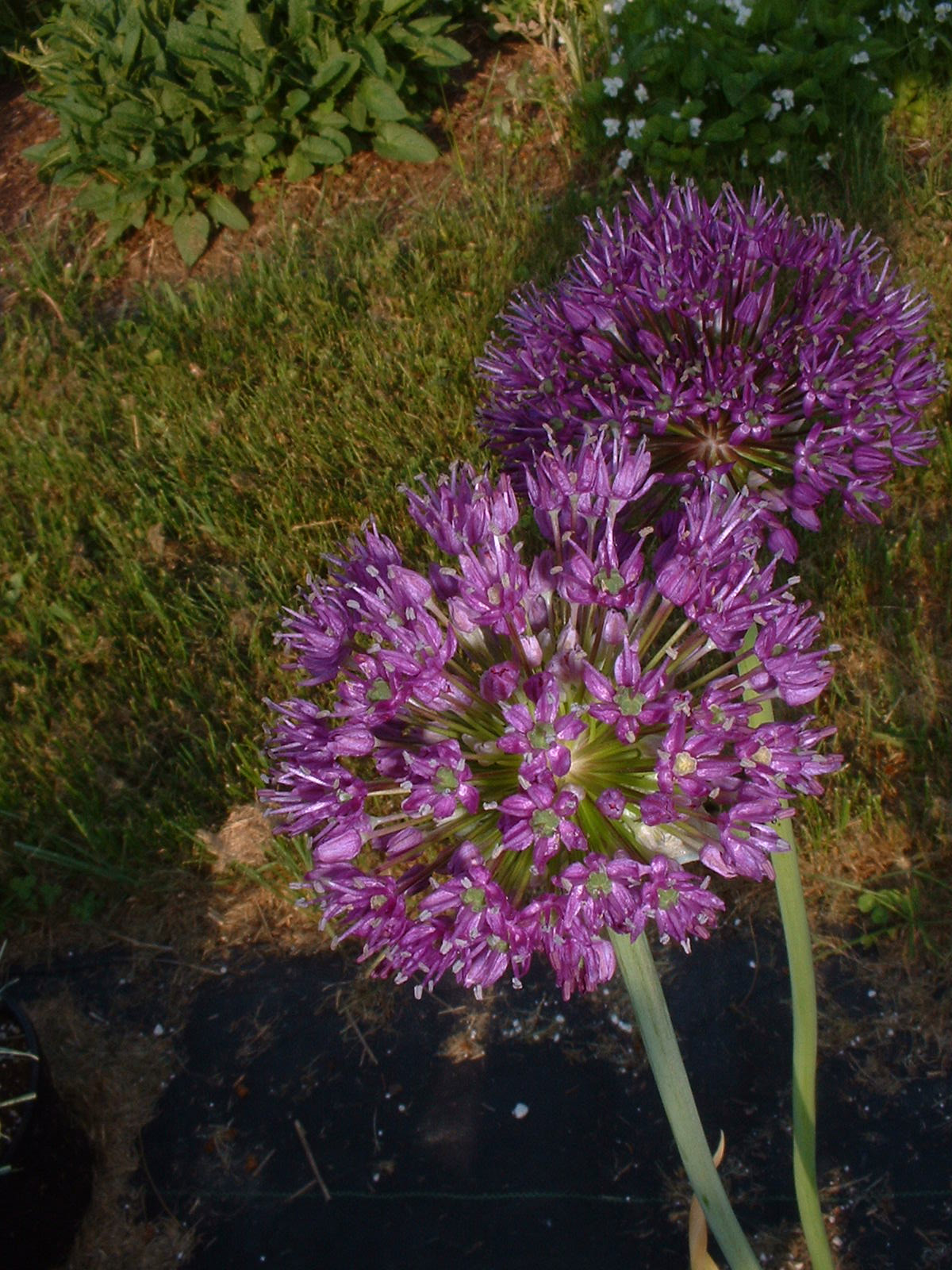
One of my favorite combination plantings is allium 'aflatunense' planted among the daylilies. They come up early and bloom while the daylilies are still putting out their initial foliage. When the daylilies are just about ready to begin blooming the foliage on the allium dries up and disappears. I simply snip off the gone-by allium blooms, but some people leave them as seed pod interest.


Above is this allium planted in a daylily display and below is a close-up. These are not the huge "Globemaster" type alliums, rather they are almost the size of a soft ball, just right in my opinion.


I am planting them in pots now for spring sales, but the best bet is to buy the bulbs now and get them in the ground before it freezes.

Another shorter allium I love for its foliage and spring flowers is Allium Karataviense.

This allium is perfect for the front of borders or rock gardens. It has golf-ball sized blooms on 10 inch stems and it is the combination of those blooms and the broad fleshy foliage that appeals to me.

Years ago I bought a pot of Oxalis Adenophylla from a nursery and they did well for quite a few years in my shade garden as a spring bloomer.


It is one funny looking bulb, and I plant it in pots every fall for spring sales with limited success. But planted directly in the soil it should do fine.


When the first gardeners visit my business in the spring, they all seem to love 'trout lily' (erythronium) or some call it "dog's tooth violet." These have increased every year for me. They go dormant and completely disappear by early summer.


Another plant that folks have asked me about in my spring garden is the species tulip, Dasystemon 'Tarda.' It resembles a crocus more than a the flower we associate with Dutch tulips, but it's a good perennial, self-seeding where happy. The blooms last a long time and are a great way to welcome the new growing season.


For quite a few years I had a showy orange Fritillaria imperialis in a display garden. I tried planting it in the fall in pots for the spring sales and in the ground to dig and pot up in the spring, without any luck. This fall I am planting some frittilaria MELEAGRIS.


It is supposed to do well in a sheltered spot in the garden, and I'm thinking it will be nice with the Trout Lily. This is called the "checkered lily" and the following photo is from the bulb company I use.


It has been around since 1575 and is rated zone 3-8, so it certainly has proven its mettle.

I always buy some tulips to plant in our village and treat them like annuals. There's nothing subtly about my selection for this year's planting, "Holland's Glory." Here in northern Vermont we have a short growing season. Our winters can be cold and mean, followed by a challenging mud season, so we like our blooms loud and cheerful.


I hope this will make folks smile next spring.

Sunday, October 3, 2010

Fall Photographs

I officially closed my business for the season Oct. 1. All but one of the mums sold at farmers' market (some seen here before loading)


I stopped on my way home to take some of the same photos that I'm sure "leaf peepers" take.


We had a lot of rain last week, flooding the fields across the road to the point that three people got in a canoe and paddled around in a pond that covered a hay field.


One of my very favorite plants for winter interest is miscanthus ‘siberfeder’. It stands up to all kids of weather, is lovely in every light, and is still upright and proud in the spring.


I also sell Calamagrostis x acutiflora 'Karl Foester" which was named the 2001 perennial plant of the year, but I only do that because people ask for that one. It grows too fast for my taste and quickly becomes just grass in the garden. I prefer a stand of grass that adds vertical structure my plantings. I haven't had much luck with other grasses, but will keep trying.

When I left the Department of Agriculture 20+ years ago my staff gave me a small weeping crab apple tree which I popped in the lawn by the driveway. It has grown well every year and always provides food for the birds that stick around late into the fall. This year the fruit yield is unbelievable.


The robins will think they have landed in heaven.

Sunday, September 12, 2010

More Fall Perennials

Amanda at St. Johnsbury Farmers' Market ...


We are entering the Mum season big time right now and tend to sell almost all the plants we take to our two farmers' markets.


They look good and "the price is right" ($3.50 - $6.50.) I am so ready to wrap up the season and start planning seriously for next year. There are four greenhouses filled with mums and of course they're outside too.


Meanwhile, I am scarfing up any late blooming perennials I can find for bouquets and combining them with remaining annuals.


The bouquets really are pretty and I sell them for $5 each, because it's a fun project for me. But I tell people if they want one made specifically for an event ... it will be a lot more.

Cimicifugia (bugbane or snakeroot) is in full bloom right now. It is a tall graceful specimen plant that does fine here in full sun or part shade.


Ligularia 'Britt Marie Crawford' has nice bronze leaves when grown here in full sun (other ligularias prefer more shade) and the yellow daisy blooms are welcome in the fall.


Buddleia (buterfly bush) is marginally hardy here. This one variety, 'Pink Delight' did well here for five years, and this fall it is still alive, but not blooming much. I remember these plants being huge and covered with blooms in Connecticut.


Clara Curtiss is the one true "perennial mum" that seems to thrive here.


Another mum that does overwinter, but has been a big disappointment for me, is 'Rosy Igloo.' This is the promotional shot of the bloom, but in fact it's quite small and (to my eye) dull.


As my Dad used to say - Onward!

Tuesday, August 31, 2010

Late Blooming Perennials

This is the time of year when perennial gardens are running out of steam and customers come in looking for something that is “...blooming right now.” Unfortunately a lot of the late bloomers are also very tall, so hard to sell late in pots.

Artemisia lactiflora is a nice early fall bloomer.


Unlike most artemisias, this plant is not invasive and it can grow in moist soil. I use the feathery sprays of blooms in fall bouquets.

The species of Joe Pye Weed (Eupatorium purpureum) spreads quickly and can be unmanageable. I like the cultivar, ‘gateway’ which is bushier than the species. I was also excited about the possibilities of ‘Little Joe’ eupatorium, advertised as a “dwarf” version , 3 - 4’ tall, but it’s still at least 5’ tall in my gardens.


In the foreground of the above photo is one of my favorites - ‘Lorraine sunshine’ heliopsis. One of my customers says: “This plant makes me smile.” It has great variegated foliage which has not yet reverted back to green. The flowers are long lasting, making it nice for the garden and bouquets.


Last but not least, is one of my favorites - Purple Showers viola. Often, and it is the case this year, this perennial blooms the entire growing season. It’s grown from cuttings, so doesn’t spread all over the place by self-seeding. Rather it remains in manageable clumps of color. I’ve been using it as a cut flower for small bouquets. It has been called the “energizer bunny” of violas.


Saturday, August 14, 2010

Perennials for Foliage

Flowers come and go on perennials, but their foliage is a permanent part of the garden landscape. I think shapes and textures of the plants are just as important as blooms, particularly as summer comes to an end and flowers are limited.

Hostas are the first plants that come to mind when considering foliage.

Above is an "oldie," Gold Standard. In front of the hosta are the spotted leaves of a pulmonaria.

This above hosta is Sun Power (planted in full sun) and behind is the maroon foliage of Britt Marie Crawford Ligularia. Hosta has its fair share of problems, namely it is filet mignon to the deer and slug population.


Jack Frost Brunnera (above) is a fairly recent introduction to the perennial world and it will become a classic. The silver foliage glows in the shade garden. It has inconsequential small blue flowers in the spring.


Its parent, Brunnera macrophylla, which I call "perennial forget-me-not" is loaded with flowers in the spring, and keeps the nice heart-shaped leaves all season, but doesn't stand out like its sport. Brunnera have no insect problems and the deer don't eat them either.

Sedums also have nice foliage (and few pest problems.) Below is Autumn Charm.


Besides yellow and silver and maroon leaved perennials, the foliage itself may be matted, mounded, spiky or arching, all creating a sense of contrast in the gardens.

With this summer's heat our "shade garden" has been a pleasant place to relax. Below is a photo of mixed foliage, mostly european ginger and variegated carex (sedge).

I love European ginger. Unlike American wild ginger, this cultivar has glossy leaves which gradually carpet the ground. It has strange flowers under the leaves that are unnoticeable.


Another plant I like for its foliage and form is amsonia tabernaemontana. It has pale blue flowers in the spring, which are barely noticeable to my eye, but in full sun it grows into a completely trouble free mounded plant that looks like a shrub. In the late summer I use the foliage to fill in bouquets.


Above the amsonia is seen behind a mat of low-growing perennial geranium.

Cimicifuga is another nice plant for its arching shape. This plant has an interesting collection of common names - "Black Cohosh," "Snake root" and "Bugbane." The foliage also comes in various darker shades, although these grow slowly for me. This one is Brunette.


Folks are straggling in now looking for fall blooming perennials, so that will be my next blog entry!

Friday, July 30, 2010

My Vermont Summer Garden

It is a cool evening, family and visitors have left, and the weather is once again pleasant. This is a photo of a four-year-old persicaria polymorpha, or giant fleece flower.

Persicaria Polymorpha

Descriptions usually list it as 5' tall. Ours is always at least 8' tall with no particular encouragement. It looks like a cross between a lilac and an astilbe on steroids and it is in bloom for about two months. Customers assume it is a shrub, but it's a perennial and as such needs to be cut back in the fall, quite a project.

Another successful plant this summer is 'red romaine' lettuce.

'Red Romaine' Lettuce

I bought heirloom seeds and was pleased with the rich burgundy color. It brightened up the salads and was a nice garnish as well.


Clematis 'Madame Julia Correvon (above) has always done well for me. It has smaller red flowers.


I also like to use clematis (here Jackmanii) for bouquets. This arrangement also has cupids dart (Catananche caerulea), annual bachelor buttons and tall ageratum.

I rely on lavatera for cut flowers.

Lavatera Trimestris


I put a few coleus and one perilla (above left) together in a pot to add color to the perennial display gardens. I have been a bit disappointed with coleus 'red head' (lower right), as I had visions of it becoming a bright red for the entire summer. It is more of a muted red. But coleus Florida City Yalaha (above right) is a bright winner.


'Fresh Look' celosia (above) is easy to grow from seed and is splashy in the garden. Here I have planted it with 'Lemon Gem' marigolds, which have completely stopped blooming and are non-performers for the time being. I'm not sure why they are on strike.

I always grow amaranthus tricolor ('Joseph's Coat') because I enjoy its tropical look.


Amaranthus Tricolor

Here's another amaranthus that has lost its tag. It came highly recommended from either Fedco or Johnnies. It certainly is a performer, but tends to overwhelm the garden. I do, however, now think it might be fun to have a garden with just amaranthus varieties, as there are so many different types and they are all on the wild side. Next year?


I often suggest to my customers that they think about foliage contrast for the impression of color, since perennials, with a few exceptions, do not bloom all summer. Ligularia 'Britt-Marie Crawford' has dark maroon foliage and does fine in full sun. Here it is planted next to 'Sun Power' hosta.


Another nice foliage plant is heliopsis 'Lorraine Sunshine.' The foliage holds its variegation (many plants revert back to green) and it is particularly lovely when in bloom.


We have actually started to sell a few mums, which is a good thing since they are budding up early. And I am already ordering plants and seeds for next year.