Showing posts with label Bouquets. Show all posts

Wednesday, February 29, 2012

Sunflowers for Bouquets

I’m a great fan of sunflowers (Helianthus annus) and my favorites have the smaller blooms that are easy to use in bouquets. Johnny’s Seeds in Maine is one good place to find a great selection. Or you can swing by Amanda’s Greenhouse to get the plants!

I’m planting several new varieties this year. 'Procut Gold' appeals to me because it is early (50-60 days), pollenless, and has a relatively small bloom (3 - 4").


PROCUT GOLD SUNFLOWER
(Photo from Harris Seed catalogue)


I'm sold on the photos of 'Starburst Lemon Aura.' It is a double, kind of fluffy looking sunflower. It is on the large size for my tastes, 8", but it is pollen free and I love its appearance. We shall see.


STARBURST LEMON AURA
(Photo from Vermont Bean Seed Company)


Johnny’s Seeds describe 'Peach Passion' as a “fantastic branching variety with high yields ... ideal for arrangements.” It is a pollenless semi-double bloom - 4” across.


PEACH PASSION
(Photo from Harris Seed Catalogue)


'Florenza' has a 5" bi-color burgundy bloom with yellow tips. The "strong branching trait" appeals to me, as that should mean more flowers for bouquets.


Other sunflowers I like for bouquets include 'Moulin Rouge', 'Joker', 'Soraya', and 'Sonja.' Last year I had good luck with 'Autumn Beauty Mix'. I have no idea which varieties are included, but I got loads of cuts off a small planting and will try that mix again.


AUTUMN BEAUTY MIX
(Photo from Veseys Seed Catalogue)

Sunday, September 12, 2010

More Fall Perennials

Amanda at St. Johnsbury Farmers' Market ...


We are entering the Mum season big time right now and tend to sell almost all the plants we take to our two farmers' markets.


They look good and "the price is right" ($3.50 - $6.50.) I am so ready to wrap up the season and start planning seriously for next year. There are four greenhouses filled with mums and of course they're outside too.


Meanwhile, I am scarfing up any late blooming perennials I can find for bouquets and combining them with remaining annuals.


The bouquets really are pretty and I sell them for $5 each, because it's a fun project for me. But I tell people if they want one made specifically for an event ... it will be a lot more.

Cimicifugia (bugbane or snakeroot) is in full bloom right now. It is a tall graceful specimen plant that does fine here in full sun or part shade.


Ligularia 'Britt Marie Crawford' has nice bronze leaves when grown here in full sun (other ligularias prefer more shade) and the yellow daisy blooms are welcome in the fall.


Buddleia (buterfly bush) is marginally hardy here. This one variety, 'Pink Delight' did well here for five years, and this fall it is still alive, but not blooming much. I remember these plants being huge and covered with blooms in Connecticut.


Clara Curtiss is the one true "perennial mum" that seems to thrive here.


Another mum that does overwinter, but has been a big disappointment for me, is 'Rosy Igloo.' This is the promotional shot of the bloom, but in fact it's quite small and (to my eye) dull.


As my Dad used to say - Onward!

Friday, July 30, 2010

My Vermont Summer Garden

It is a cool evening, family and visitors have left, and the weather is once again pleasant. This is a photo of a four-year-old persicaria polymorpha, or giant fleece flower.

Persicaria Polymorpha

Descriptions usually list it as 5' tall. Ours is always at least 8' tall with no particular encouragement. It looks like a cross between a lilac and an astilbe on steroids and it is in bloom for about two months. Customers assume it is a shrub, but it's a perennial and as such needs to be cut back in the fall, quite a project.

Another successful plant this summer is 'red romaine' lettuce.

'Red Romaine' Lettuce

I bought heirloom seeds and was pleased with the rich burgundy color. It brightened up the salads and was a nice garnish as well.


Clematis 'Madame Julia Correvon (above) has always done well for me. It has smaller red flowers.


I also like to use clematis (here Jackmanii) for bouquets. This arrangement also has cupids dart (Catananche caerulea), annual bachelor buttons and tall ageratum.

I rely on lavatera for cut flowers.

Lavatera Trimestris


I put a few coleus and one perilla (above left) together in a pot to add color to the perennial display gardens. I have been a bit disappointed with coleus 'red head' (lower right), as I had visions of it becoming a bright red for the entire summer. It is more of a muted red. But coleus Florida City Yalaha (above right) is a bright winner.


'Fresh Look' celosia (above) is easy to grow from seed and is splashy in the garden. Here I have planted it with 'Lemon Gem' marigolds, which have completely stopped blooming and are non-performers for the time being. I'm not sure why they are on strike.

I always grow amaranthus tricolor ('Joseph's Coat') because I enjoy its tropical look.


Amaranthus Tricolor

Here's another amaranthus that has lost its tag. It came highly recommended from either Fedco or Johnnies. It certainly is a performer, but tends to overwhelm the garden. I do, however, now think it might be fun to have a garden with just amaranthus varieties, as there are so many different types and they are all on the wild side. Next year?


I often suggest to my customers that they think about foliage contrast for the impression of color, since perennials, with a few exceptions, do not bloom all summer. Ligularia 'Britt-Marie Crawford' has dark maroon foliage and does fine in full sun. Here it is planted next to 'Sun Power' hosta.


Another nice foliage plant is heliopsis 'Lorraine Sunshine.' The foliage holds its variegation (many plants revert back to green) and it is particularly lovely when in bloom.


We have actually started to sell a few mums, which is a good thing since they are budding up early. And I am already ordering plants and seeds for next year.

Friday, March 5, 2010

Great Flowers - Poor Sellers

Sometimes I am the only customer for some of the flowers I grow. There are a number of reasons for this. Many gardeners are not familiar with these plants and I don’t have photo tags for them. Seed catalogs push new varieties and they also carry the most popular, familiar varieties.

I always plan on advertising the underused flowers better with photos and information .... and I don’t find the time.

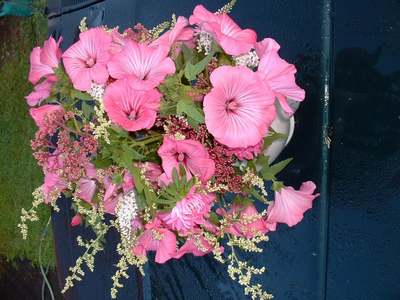
One of my favorites flowers is lavatera trimestris or "rose mallow". It is related to hibiscus and hollyhock and can bloom up to five feet, but the common ‘silver cup’ is typically about 3 - 4 feet. Lavateras do best in areas with cool summers, so here in central/northern Vermont they usually do well.


LAVATERA


The most common cultivar is a pale pink. I like 'tanagra' as well, which is rosier, and there is a shorter white version.


'Tanagra' LAVATERA


'Twins White' LAVATERA


Not only is this a showy bloomer most of the summer, it’s also great in bouquets. At farmers’ markets, my bouquets with lavatera sell first.


Summer visitors are always surprised by my tithonia. It’s a bright orange flower and a real stand-out. I have seen it listed as a good cut flower, but I find it better for display, as the stem is hollow and it hasn’t held up well for me in bouquets.


'Torch' TITHONIA


'Twinkle' phlox is an adorable short (8”) grower, good for sunny borders front of borders. It comes in a mix of bright colors.


Twinkle Phlox


I also like tri-colored amaranthus. It's a head turner and is actually an edible herb, although I haven't tried it in that capacity.


AMARANTHUS tri-colored


Verbena bonariensis is a perennial south of us, but here it is a well-loved annual. It blooms from mid-summer until frost and butterflies love it. It is tall (4 - 5 feet), but needs no staking. Its lavender ball-like blooms are somewhat similar to allium, but there are tons of them on slim branches, giving it an airy, swaying appearance. It is one of those delicate looking plants that's actually tough. I have a few customers who buy these by the tray for landscaping, but very rarely do I sell a single six pack.


Verbenea Bonariensis


All of these plants do best in full sun here.

Tuesday, February 16, 2010

Deer and My Garden ~ ~ ~ and Deer-resistant Cut Flowers


I am not a hunter, but when I see deer grazing in my perennial gardens I find myself thinking unkind thoughts about the graceful creatures.

A good fence or a gun are really the only two surefire ways to keep deer out of your gardens. I’ve tried human hair, blood meal, soap bars, urine of all sorts, and all kinds of sprays.

The best product I have used is called Tree Guard. It has Bitrex in it, a bitter compound that has been used to stop children from sucking their thumbs, and also has a latex to adhere to the leaves. Unfortunately the latex gummed up my sprayers and perhaps the company has now fixed this problem. This spray does last a few months with one application, but of course it wouldn’t effect new growth. In my case I have too many plants in too many places to maintain the sprays.

A few years ago the deer were so plentiful that while we slept they were walking up and down the benches of plants for sale, munching whatever appealed to them: a Bambi buffet. And so we constructed a fence around the shade display garden and another fence around the area where we keep hostas and surplus plants.

We forgot to close the door one night and a bear wandered into the enclosure, realized s/he was fenced in, and completely tore down one side of the fence to escape.


Deer are hungriest in the early spring when the first shoots in a garden must look extremely appetizing. One year a friend and I decided to fill our village shopping area with spring flowers. Twenty window boxes crowded with tulips poking out of the soil were ready to move. I put them by the driveway to be picked up. The next morning it looked as if a herd of elephants had attacked the boxes. Half of them were knocked over and every tulip was destroyed. The answer, for spring flowers, is daffodils.

If the deer are hungry enough, they will munch on just about anything, but there are certain plants they generally find unappealing. They’d rather not eat fuzzy leaves like lambs’ ears or foliage with aromatic leaves such as ornamental oregano or most herbs. I have no idea why they gobble my roses, thorns and all, and seem to like tomatoes as well. Supposedly they don’t eat poisonous plants, but they munch on my smaller delphiniums.

From my 20 plus years of donating plants to the deer, I have found they usually leave certain plants alone, and using that knowledge I am planning a deer resistant garden just for cut flowers with the following plants:

Perennials

Aconitum (monkshood)
Achillea (yarrow)
Amsonia
Artemesia
Astilbe
Astrantia
Baptesia (false indigo)
Digitalis ambigua (a true perennial foxglove)
Echinacea (cone flower)
Monarda (bee balm)
Nepata (cat mint)
Peonies
Salvia

Annuals -
Blue salvia
Cleome
Cutting marigolds
Dahlia
Snap Dragons

There is a nursery in Michigan that only sells deer resistant plants, so you can look up www.deerresistantplants.com to see what they recommend. And keep your fingers crossed.

Wednesday, August 19, 2009

More Bouquets for Farmers' Market

I thought it would be fun to take various containers and use them as vases for my flowers for farmers’ market. I chose an old tea pot that had a crack, so it couldn’t be used for tea; a sweet pottery vase; a little brass vase; and an older planter with a chip, among other things.

They were meant to be whimsical and quirky, but I sold them all right away to one person to be used for a wedding! I don’t think they even noticed the containers - she just liked the flowers... and at $7 a bouquet, it was a bargain. (Sorry, the second photo should have been rotated one more time...)


Sunday, August 9, 2009

Wedding Flowers for a Friend

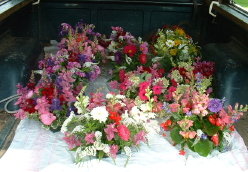
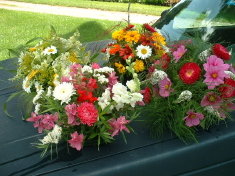
One of my best friends is also an employe of 14 years, Rose Bothfeld. Her son, Raymon, got married this weekend and I volunteered to make the table bouquets for the wedding as a gift. It turned out they needed 22 bouquets. Rose and I picked flowers Thursday evening at a friend’s flower farm to supplement what I could provide from my gardens.

I am most comfortable making bouquets with oasis, as compared to “loose” bouquets. It’s really easy and most florist are fine with selling you a few containers and a brick of oasis. I take the round container, place in a hunk of oasis and then moisten it thoroughly with water with preservative.


Then I usually make a general foundation of foliage. Astilbe and peony leaves work great for this, but I also use hosta, amsonia and the dark leaves of ninebark.


I can do this a day or two before the actual bouquets get done. One nice thing about giving the flowers as a gift is that I was told any color combination was fine. So some tables got blue bouquets, while others got shades of yellow with ornamental grass and many just got wild mixes.

They came out really nicely and I was proud to deliver them Saturday afternoon. The first photo is the bottom layer of the truck.


The bridegroom is a farmer and he met me at the house in soiled clothes (“I still have to tie up the cows”). He had three hours until the wedding and he said his tux was ready.

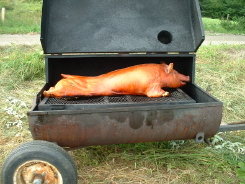
This was a real country wedding with potluck dishes and BYO drinks. And then there was this - a Vermont wedding really needs a pig roast!