Showing posts with label Cut Flowers. Show all posts

Wednesday, August 22, 2012

(Some of) My Favorite Plants

Plants perform differently every growing season depending on the weather.  I occasionally find myself crazy about a plant and two weeks later when the blooms have diminished ... not so much.  Here are some of my favorites from this year.

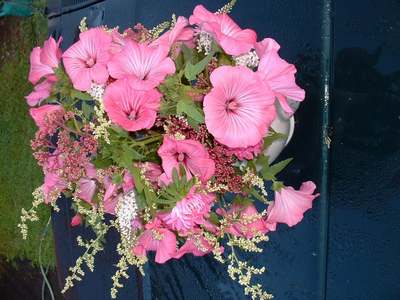
Every year I am a big fan of lavatera trimestris 'Silver Cup.'  This rose mallow is covered with large pink flowers and they are excellent in bouquets.

'Silver Cup' Lavatera


Tall summer phlox can be tricky because of powdery mildew.  Even the highly touted 'David' does not completely escape from the attack here.  My favorite phlox for performance, fragrance and bouquets is 'Laura.'

'Laura' Phlox

Rudbeckia 'Denver Daisy' has been another great performer in my garden this year.

'Denver Daisy' Rudbeckia

And year after year 'Annabelle' hydrangea has never let me down.  Besides its manageable height and long lasting flowers, the fact that it blooms in part shade is a big plus.

'Annabelle' Hydrangea

It has been a hot and dry summer and some of my hostas exposed to the sun have not faired well. 'Sun Power' hosta has lived up to its name, providing a nice burst of color all season.

'Sun Power' Hosta

I never go without a tall blue ageratum for cutting.  They are not bothered by disease or bugs and are very long lasting in bouquets.


'Dondo Blue' Ageratum


And the mums are just beginning to show color ... and just beginning to sell.

Wednesday, February 29, 2012

Sunflowers for Bouquets

I’m a great fan of sunflowers (Helianthus annus) and my favorites have the smaller blooms that are easy to use in bouquets. Johnny’s Seeds in Maine is one good place to find a great selection. Or you can swing by Amanda’s Greenhouse to get the plants!

I’m planting several new varieties this year. 'Procut Gold' appeals to me because it is early (50-60 days), pollenless, and has a relatively small bloom (3 - 4").


PROCUT GOLD SUNFLOWER
(Photo from Harris Seed catalogue)


I'm sold on the photos of 'Starburst Lemon Aura.' It is a double, kind of fluffy looking sunflower. It is on the large size for my tastes, 8", but it is pollen free and I love its appearance. We shall see.


STARBURST LEMON AURA
(Photo from Vermont Bean Seed Company)


Johnny’s Seeds describe 'Peach Passion' as a “fantastic branching variety with high yields ... ideal for arrangements.” It is a pollenless semi-double bloom - 4” across.


PEACH PASSION
(Photo from Harris Seed Catalogue)


'Florenza' has a 5" bi-color burgundy bloom with yellow tips. The "strong branching trait" appeals to me, as that should mean more flowers for bouquets.


Other sunflowers I like for bouquets include 'Moulin Rouge', 'Joker', 'Soraya', and 'Sonja.' Last year I had good luck with 'Autumn Beauty Mix'. I have no idea which varieties are included, but I got loads of cuts off a small planting and will try that mix again.


AUTUMN BEAUTY MIX
(Photo from Veseys Seed Catalogue)

Tuesday, August 31, 2010

Late Blooming Perennials

This is the time of year when perennial gardens are running out of steam and customers come in looking for something that is “...blooming right now.” Unfortunately a lot of the late bloomers are also very tall, so hard to sell late in pots.

Artemisia lactiflora is a nice early fall bloomer.


Unlike most artemisias, this plant is not invasive and it can grow in moist soil. I use the feathery sprays of blooms in fall bouquets.

The species of Joe Pye Weed (Eupatorium purpureum) spreads quickly and can be unmanageable. I like the cultivar, ‘gateway’ which is bushier than the species. I was also excited about the possibilities of ‘Little Joe’ eupatorium, advertised as a “dwarf” version , 3 - 4’ tall, but it’s still at least 5’ tall in my gardens.


In the foreground of the above photo is one of my favorites - ‘Lorraine sunshine’ heliopsis. One of my customers says: “This plant makes me smile.” It has great variegated foliage which has not yet reverted back to green. The flowers are long lasting, making it nice for the garden and bouquets.


Last but not least, is one of my favorites - Purple Showers viola. Often, and it is the case this year, this perennial blooms the entire growing season. It’s grown from cuttings, so doesn’t spread all over the place by self-seeding. Rather it remains in manageable clumps of color. I’ve been using it as a cut flower for small bouquets. It has been called the “energizer bunny” of violas.


Tuesday, February 16, 2010

Deer and My Garden ~ ~ ~ and Deer-resistant Cut Flowers


I am not a hunter, but when I see deer grazing in my perennial gardens I find myself thinking unkind thoughts about the graceful creatures.

A good fence or a gun are really the only two surefire ways to keep deer out of your gardens. I’ve tried human hair, blood meal, soap bars, urine of all sorts, and all kinds of sprays.

The best product I have used is called Tree Guard. It has Bitrex in it, a bitter compound that has been used to stop children from sucking their thumbs, and also has a latex to adhere to the leaves. Unfortunately the latex gummed up my sprayers and perhaps the company has now fixed this problem. This spray does last a few months with one application, but of course it wouldn’t effect new growth. In my case I have too many plants in too many places to maintain the sprays.

A few years ago the deer were so plentiful that while we slept they were walking up and down the benches of plants for sale, munching whatever appealed to them: a Bambi buffet. And so we constructed a fence around the shade display garden and another fence around the area where we keep hostas and surplus plants.

We forgot to close the door one night and a bear wandered into the enclosure, realized s/he was fenced in, and completely tore down one side of the fence to escape.


Deer are hungriest in the early spring when the first shoots in a garden must look extremely appetizing. One year a friend and I decided to fill our village shopping area with spring flowers. Twenty window boxes crowded with tulips poking out of the soil were ready to move. I put them by the driveway to be picked up. The next morning it looked as if a herd of elephants had attacked the boxes. Half of them were knocked over and every tulip was destroyed. The answer, for spring flowers, is daffodils.

If the deer are hungry enough, they will munch on just about anything, but there are certain plants they generally find unappealing. They’d rather not eat fuzzy leaves like lambs’ ears or foliage with aromatic leaves such as ornamental oregano or most herbs. I have no idea why they gobble my roses, thorns and all, and seem to like tomatoes as well. Supposedly they don’t eat poisonous plants, but they munch on my smaller delphiniums.

From my 20 plus years of donating plants to the deer, I have found they usually leave certain plants alone, and using that knowledge I am planning a deer resistant garden just for cut flowers with the following plants:

Perennials

Aconitum (monkshood)
Achillea (yarrow)
Amsonia
Artemesia
Astilbe
Astrantia
Baptesia (false indigo)
Digitalis ambigua (a true perennial foxglove)
Echinacea (cone flower)
Monarda (bee balm)
Nepata (cat mint)
Peonies
Salvia

Annuals -
Blue salvia
Cleome
Cutting marigolds
Dahlia
Snap Dragons

There is a nursery in Michigan that only sells deer resistant plants, so you can look up www.deerresistantplants.com to see what they recommend. And keep your fingers crossed.

Sunday, August 23, 2009

Great Flowers - Poor Sellers

Oh fickle customers - they do seem to snap up whatever is blooming in the six-packs in the spring, and bypass the “starts” that are still green. I am at fault too, as I should whip up some nice POP (point of purchase) posters to show folks what they will be missing. Every year I offer some “hard-to-find” annuals, and every year I end up with most of them still on the shelves by mid-summer.

For example, blue didiscus (below.) It’s kind of like a smaller version of the white queen anne’s lace, very pretty as a filler in summer bouquets.


Lavatera comes in various shades of pink and a shorter white version and once it starts blooming it is loaded with hibiscus like flowers and makes for a great cut flower. This time of year I am cutting lavatera every day.


Sanvitalia procumbens ("creeping zinnia") is great for hot dry areas.


Tithonia (“Mexican Sunflower”) is a nice splash of color for the summer garden. The stems are hollow and it is not good for bouquets, but it is a show stopper.


While rudbeckia (black-eyed susan) can be a fine perennial (I think the best is 'goldsturm'), there are also many nice rudbeckias that I grow as annuals, including ‘Indian Summer’, ‘Prairie Sun,’ ‘Tiger Eye,’ and the ‘Toto’ series. Next year I will offer ‘Cherry Brandy,’ the first red-flowered black-eyed susan grown from seeds.


I have always thought it would be a good idea to have a “Gourmet Corner” in one greenhouse for the hard-to-find flowers. Maybe This will happen "next year”?

Wednesday, August 19, 2009

More Bouquets for Farmers' Market

I thought it would be fun to take various containers and use them as vases for my flowers for farmers’ market. I chose an old tea pot that had a crack, so it couldn’t be used for tea; a sweet pottery vase; a little brass vase; and an older planter with a chip, among other things.

They were meant to be whimsical and quirky, but I sold them all right away to one person to be used for a wedding! I don’t think they even noticed the containers - she just liked the flowers... and at $7 a bouquet, it was a bargain. (Sorry, the second photo should have been rotated one more time...)


Sunday, August 9, 2009

Wedding Flowers for a Friend

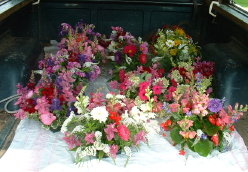
One of my best friends is also an employe of 14 years, Rose Bothfeld. Her son, Raymon, got married this weekend and I volunteered to make the table bouquets for the wedding as a gift. It turned out they needed 22 bouquets. Rose and I picked flowers Thursday evening at a friend’s flower farm to supplement what I could provide from my gardens.

I am most comfortable making bouquets with oasis, as compared to “loose” bouquets. It’s really easy and most florist are fine with selling you a few containers and a brick of oasis. I take the round container, place in a hunk of oasis and then moisten it thoroughly with water with preservative.


Then I usually make a general foundation of foliage. Astilbe and peony leaves work great for this, but I also use hosta, amsonia and the dark leaves of ninebark.


I can do this a day or two before the actual bouquets get done. One nice thing about giving the flowers as a gift is that I was told any color combination was fine. So some tables got blue bouquets, while others got shades of yellow with ornamental grass and many just got wild mixes.

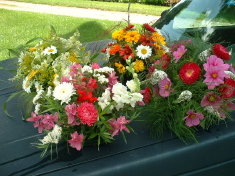
They came out really nicely and I was proud to deliver them Saturday afternoon. The first photo is the bottom layer of the truck.


The bridegroom is a farmer and he met me at the house in soiled clothes (“I still have to tie up the cows”). He had three hours until the wedding and he said his tux was ready.

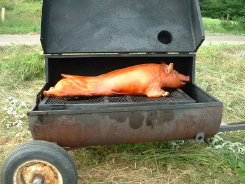
This was a real country wedding with potluck dishes and BYO drinks. And then there was this - a Vermont wedding really needs a pig roast!


Thursday, July 16, 2009

Pleasing Perennials Blooming Now

While my all-time favorite perennial shasta Daisy is ‘Becky’ (great for flower arrangements), I like this shorter version, ‘Snow Cap.’


Heliopsis (“false sunflower”) blooms for a long time in my gardens and it’s another good plant for cuts. ‘Lorraine Sunshine’ is a relatively new introduction to the perennial industry. It holds its variegation, and as one customer said, “It makes me smile.”


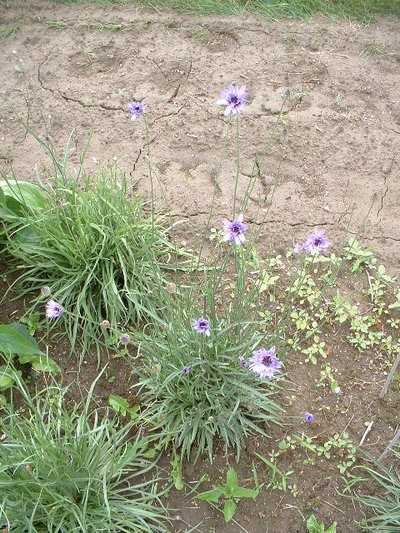
Catananche, or “cupid’s dart” isn’t particularly showy, but it is an excellent cut flower and because it’s pretty darned close to true blue, it goes with anything in a bouquet.

Monday, June 30, 2008

Bouquets from Your Garden


I enjoy making bouquets for myself and occasionally am asked to supply arrangements for weddings and large events. Because I have perennials growing in the fields, there’s usually something to choose from, and this article will talk about how to make a long lasting bouquet and my favorite flowers for that purpose.

The best time to cut flowers is in the cool of the morning or in the evening. Morning flowers are turgid and less likely to wilt. For a big job I typically cut flowers in the morning, let them “rest” with preservatives in a cool place during the day, and make the arrangements that evening.

The rule of thumb is to cut newly opened flowers without pollen showing. Once the flower is pollinated it immediately begins the process of fading and forming seed.

Using clean scissors, it’s best to put the stems in warm water which greatly increases water uptake. In the field I cut long stems and strip off the bottom leaves to help prevent decay. Once the bouquet is made I cut the stems one more time.

Floral preservatives definitely prolong the life of a bouquet. They supply food and acidifier. Plants take up acidified water (ph 3.5 - 4.5 ) much faster than nonacid water. If you want to make your own preservative, add 1 teaspoon vinegar, 1 tablespoon sugar and one crushed aspirin tablet to 24 ounces of water. The aspirin helps prevent bacteria and you won’t get that nasty smelling water. Another recipe I have seen is to combine 1 cup regular 7-Up, 1 cup water and 1/2 teaspoon household bleach.

Besides appearance, the most important component of a bouquet is that it be long lasting. Generally flowers that dry well also last a long time in bouquets. Yarrow, gomphrena, astrantia and larkspur would be examples.

As I write these words my Siberian iris are blooming away. I cut them in a bud stage, just as they are starting to open. By the time they are delivered most will be blooming. The buds are pretty as well but this flower is not particularly long lasting . Iris and peonies generally bloom at about the same time and are a nice combination.

One of my favorite “cuts” (below, left) is lysimachia clethroides (gooseneck). It can be an invasive beast and I grow it as a row crop, tilling on each side, but it compliments any bouquet and easily lasts at least a week.


‘Becky’ shasta daisy, which won the perennial plant of the year in 2003, (below, right) is also terrific for cutting. Unlike many other shastas, it stays upright and has a long bloom time and is also long lasting in bouquets.


Another excellent perennial for long bloom and good cuts is ‘Summer Sun’ heliopsis. Monkshood provides blue spikes, which compliment any bouquet. Bee balm comes in shades of red and pink. Astilbe is lovely, but after 4-5 days it wilts for me. I’m not crazy about liatris as a flower, but it certainly is long lasting in bouquets.
I like to use foliage in my bouquets and often use the silver stems of Valerie Finnis artemesia and branches from the burgundy-leaved ninebark.

One of the best cuts in the fall is golden rod. People think this flower is a main cause of seasonal allergies. Golden rod is NOT responsible. The pollen is heavy and sticky, designed for insect pollination, not wind. Its peak blooming period coincides with the peak of ragweed season, which is wind pollinated. The only way to get goldenrod pollen in your nasal passages is to stick the flower up your nose! Wind-blown ragweed pollen is the most common culprit for allergies.

Of course there are all kinds of great annuals for cutting, among them zinnias, asters, snap dragons and the later blooming salvia. I fail at growing zinnias. They get powdery mildew and my asters get aster yellows no matter where I plant them. Celosias are fun for bouquets and later in the season there are all kinds of grasses that look nice.

I am a great fan of lavatera. The blooms look like small hollyhocks and it is easy to grow. There are many sunflowers now available just for cutting. I particularly like Sonja which is 3 1/2 feet tall with tangerine orange blooms. I also like the tall blue ageratums for bouquets.

If you don’t happen to have cut flowers on hand, fresh bouquets are available at most farmers’ markets. Next month I will write about perennials that bloom late in the summer.

For gardening questions you can e-mail me at amanda@amandasgreenhouse.com or call me at 426-3783.