Thursday, June 21, 2012

Blue (?) Flowers for Vermont Gardens


Many flowers are called “blue” when in fact they are usually more purple than blue.  In nature you rarely find a true blue flower, and breeders find it difficult to come up with this color for the buying public.  But ... when naming a new plant, putting the word “blue” in the title will certainly help sell the product.

There are several perennial blue salvias.


'Rhapsody in Blue' Salvia


'Blue Hill' Salvia

And my customers love the “Black and Blue salvia, which is an invasive perennial in places like Texas, but in Vermont it is strictly an annual.


'Black and Blue' Salvia

The  blue tradescantia does not spread and take over like other spiderworts.


'Zwanenburg Blue' Tradescantia

'Blue Ice' Amsonia is taller than the species ( amsonia tabernaemontana) and much showier, but I like both of these plants.


'Blue Ice' Amsonia


‘Summer Skies’ siberian iris is a nice light blue.


'Summer Skies' Siberian Iris


The popular ‘Blue Wave’ petunia is definitely purple from my perspective.


But, when combined with other colors, you can get away with calling it 'blue.'


I plant various “blue” flowers as “cuts” because the darker color compliments just about every other color in a bouquet.  Among my favorites are 'Victoria' blue salvia and and any of the tall cutting ageratums.


Sunday, June 3, 2012

June Blooms in Vermont

Mama Mia - We have had three weekends in a row with great weather and the greenhouses have been emptying out at quite a pace. The geraniums I started from seed are all looking nice. 'Pinto Salmon Splash' (looks pink from a distance) is a new variety for this year.


PINTO PINK SPLASH

Outside the earlier lilacs got zapped by a hard cold snap, but the later varieties, like 'Miss Canada' are just starting to open and they all look fabulous.


'MISS CANADA' LILAC


Peonies are budding up and the ants are happy. They are attracted to a small amount of nectar and they do no harm to the flowers or plants and will disappear once the buds open up.


A Peony bud - 'CORAL CHARM'


The fern-leaved peonies have bloomed and done their thing, but here's a pretty tree peony in one of my gardens. These plants have woody stems and should never be cut down. Here in northern Vermont they overwinter, but are not particularly vigorous.


Yellow TREE PEONY

Amsonia tabernaemontana is blooming now and is one of those trouble-free perennials with no insect of disease problems whatsoever. The flowers are pleasant, but it is the habit of the plant itself which makes it desirable. It is full and upright and needs no support. Throughout the summer I cut the foliage for filler for bouquets.


AMSONIA tabernaemontana

Now that things are finally slowing down I hope to be able to post in my blog more often. And maybe I can figure out why this type suddenly turned blue!

Monday, May 7, 2012

More Greenhouse Photos

Every day has been a whirlwind of activity.   Life has involved meetings, writing gardening articles, and of course constant planting, digging and caring for plants.  


BUSY in Vermont

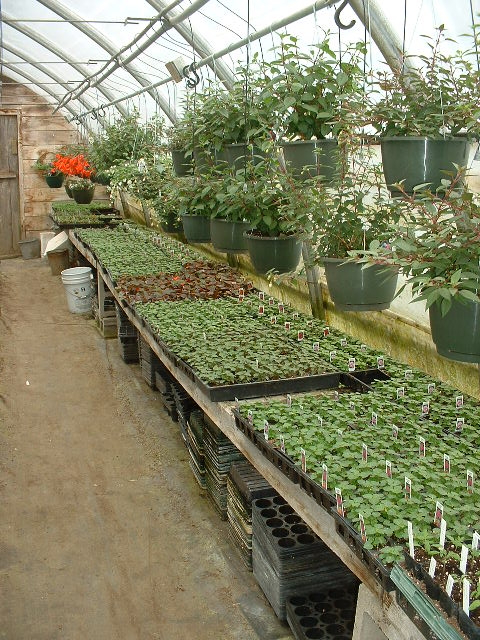
I have been too busy to blog.  Hopefully these shots can show the situation here - four greenhouses packed with plants.  We also have lots of perennials outside.


The "Tomato House"


The "Pansy House"


The "Big House"

The "Geranium House"


Left aisle in the "Big House"


Some of the benches outside

Tuesday, March 13, 2012

Hardy Roses for Northern Vermont

We have always carried hardy roses, including Therese Bugnet and Champlain, two of my favorites. They have performed well year after year and have done fine with our -20 to -30 temps with no protection at all.

Champion Rose is from Canada’s ‘Explorer’ series of hardy roses developed in Ottawa. Its flowers are a nice dark red with double petals and they bloom in clusters. The plant stays fairly short at 3 - 4’.


CHAMPION ROSE
Photo from Baileys Nursery

Therese Bugnet has double rosey pink flowers and a lovely fragrance. It’s a vigorous grower and would work well as a screen. Unfortunately Japanese Beatles have arrived and they do love this rose.


THERESE BUGNET
Photo from Baileys Nursery

Morden Sunrise is another hardy rose that produces an orange flower which fades to coral, yellow and cream. I haven't grown it here, but have good reports from Montpelier.


MORDEN SUNRISE
Photo from Baileys Nursery


Other hardy roses we carry are: William Baffin, Rambling Red, Rosa rugosa and Purple Pavement.

Tuesday, March 6, 2012

NEW Daylilies Available this Spring

Most of the following daylilies have been around for a while, but I have not had enough to divide and sell until this year. We dig most of the the plants in the early fall, pot them up and overwinter them so that they are ready to go in the spring. (We offer 125 + varieities of daylilies).

'Trahlyta' is an unusual daylily that I once offered until I ran out of stock. It’s back ... with its 6” smokey lavender bloom. It's a fragrant eye-catcher and it's a late bloomer.

TRAHLYTA
(Photo from Oakes Daylilies web site)


'Chris Salter' is an award winning daylily with 6 " medium lavender blooms. The ruffled yellow edging makes this one a stand-out.


CHRIS SALTER
(Photo from Ellie's Garden)

I have always love the appearance and performance 'Siloam' series of daylilies. They were "created" by Pauline Henry of Siloam Springs, Arkansas, and they do great here in northern Vermont. Mrs.Henry registered 490 daylilies before she died in 2000 at the age of 92. 'Siloam Double Classic,' which we sell, won the most prestigious daylily award, the Stout Silver Medal, in 1993. We offer 15 different 'Siloam' cultivars.

'Siloam Plum Tree' is one of my favorites. It’s a real beauty with 4" deep purple blooms and a small yellow throat.


SILOAM PLUM TREE
(Photo from Oakes Dayliles)

'Siloam Little Girl’ has a cute 3 and 3/4 inch round lacy pink bloom with some ruffling.


SILOAM LITTLE GIRL

'Spiritual Corridor' has a fragrant 6 " orchid lavender bloom with a pale eye and cream ruffling around the edge.


'SPIRITUAL CORRIDOR'
Photo from Walters Gardens

It's interesting to look at images of daylilies on the internet. The bloom from one cultivar will look completely different in each image depending on the photographer and how much the picture was photo-edited. The best time to buy daylilies is when they are blooming. Around here that's from the middle of July to the end of August.

Wednesday, February 29, 2012

Sunflowers for Bouquets

I’m a great fan of sunflowers (Helianthus annus) and my favorites have the smaller blooms that are easy to use in bouquets. Johnny’s Seeds in Maine is one good place to find a great selection. Or you can swing by Amanda’s Greenhouse to get the plants!

I’m planting several new varieties this year. 'Procut Gold' appeals to me because it is early (50-60 days), pollenless, and has a relatively small bloom (3 - 4").


PROCUT GOLD SUNFLOWER
(Photo from Harris Seed catalogue)


I'm sold on the photos of 'Starburst Lemon Aura.' It is a double, kind of fluffy looking sunflower. It is on the large size for my tastes, 8", but it is pollen free and I love its appearance. We shall see.


STARBURST LEMON AURA
(Photo from Vermont Bean Seed Company)


Johnny’s Seeds describe 'Peach Passion' as a “fantastic branching variety with high yields ... ideal for arrangements.” It is a pollenless semi-double bloom - 4” across.


PEACH PASSION
(Photo from Harris Seed Catalogue)


'Florenza' has a 5" bi-color burgundy bloom with yellow tips. The "strong branching trait" appeals to me, as that should mean more flowers for bouquets.


Other sunflowers I like for bouquets include 'Moulin Rouge', 'Joker', 'Soraya', and 'Sonja.' Last year I had good luck with 'Autumn Beauty Mix'. I have no idea which varieties are included, but I got loads of cuts off a small planting and will try that mix again.


AUTUMN BEAUTY MIX
(Photo from Veseys Seed Catalogue)

Friday, February 17, 2012

New Perennials at Amanda's Greenhouse

I'm always game to try new perennials. I like bee balm (monarda) as a cut flower and am looking forward to trying 'Purple Rooster.' It boasts both "true royal purple flowers" and "mildew free plants." Bee balm can be an aggressive spreader, but its roots are shallow and it is easy to thin.


'Purple Rooster' Monarda
Photo from Walters Gardens

Perennial grasses are tricky. Many of them are either too vigorous, or they do not stay upright. 'Karl Forester', a feather reed grass, was the 2001 Perennial Plant of the Year. The publicist call it a "vertical masterpiece." I am less impressed. Where I have it growing it spreads too fast does not look good all season. I'll try it somewhere else.

Meanwhile, I am forever impressed with miscanthus 'Silberfeder' (silver feather grass) which looks nice in my garden all winter. Every spring I dig around the edges to keep it from getting too big and of course to have plants to offer my customers.

Late last sumer I was visiting my friends at Cady's Falls Nursery and was very impressed with a blue switch grass, Panicum virgatum 'Heavy Metal'. It was upright and about 50 inches tall. This is one I will be growing and selling this year. This grass has metallic blue leaves which turn yellow in the fall.

'Heavy Metal' panicum virgatum
Photo from Walter's Gardens

Mildew on phlox is definitely a problem for me. 'David' seems to have the best resistance and I am adding 'David's Lavender' this year, which is supposed to have the same resistance.


David's Lavender Phlox
Photo from Walter's Gardens

Another new phlox I will be trying, because I was asked by a customer and I can't resist the photo, is 'Peppermint Twist.' It's only 16 inches tall and appears to be a real sweetheart. It is also supposed to have good mildew resistance.


Peppermint Twist Phlox
Photo from Plants Delight Web Site


Many more new plants on the horizon.

Monday, February 13, 2012

MORE New Plants for the Garden

The National Garden Bureau has named 2012 as “the Year of the Geranium.” Burpees will be offering a yellow geranium. There are so many great long lasting yellow flowers out there already, this introduction does not appeal to me.

Last year I started growing ‘Graffiti Red’ geranium, which is an exotic and unusual appearing geranium that’s been around for a while, but is hard to find.

Graffiti Red’ geranium

They produce loads of wild looking double, star-shaped flowers. I call it my “punk” geranium.

A nice development in the world of geraniums is interspecific breeding. Zonal and ivy geraniums are both grown from cuttings. The zonals are tough, upright and vigorous.

Calliope Dark Red

The ivies are pretty for hanging baskets and window boxes, but are susceptible to oedema (water ruptures the cells of the leaves) and are generally not good in full sun. So the industry has crossed the two (interspecific) and come up with excellent new geraniums, notably the ‘Caliente’ and ‘Calliope’ series.

One new variety that I will reluctantly try is 'Plentifall' pansies. They are fragrant and are bred for hanging baskets with a trailing habit of up to 24 inches. I’m sure they are lovely, but I can’t help worrying about dead heading, once the first bloom has finished.


Photo from www.vanmeuwen.com

Johnnies Selected Seeds is offering “Flower Sprout,” a cross of brussel sprouts and kale. The plant grows like a brussel sprout, and develops decorative, edible rosettes. This is something that will be fun to try, but it is backordered until May.

Gardening is a joy for me and experimenting with new plants is part of the fun.

Sunday, February 12, 2012

What is New for the Garden

First, I'll tell you what is new for me - both knees. I had bilateral knee surgery in December and have spent most of the winter recovering, exercising, and generally getting back on my feet again.

We are having a mild winter here in northern Vermont and I know the lack of snow has been difficult for anyone associated with winter recreation. We covered our perennials in pots later than usual, but I still worry that they got too warm under the various layers. We shall see.

Meanwhile I am ready to start blogging again about one of my greatest pleasures - gardening.

Every year the All-American Selections competition (AAS) chooses the “best new, never-before-sold plant varieties.” Four entries with “superior garden performance” are given the AAS Award. The competition has introduced a total of 637 plants since 1933.

Some of the past AAS winning plants, like ‘Bright Lights’ swiss chard or ‘Sensation’ cosmos have gone on to become classics. Others, like ‘Harkness’ tomato and ‘Melody’ marigold have disappeared from the horticultural marketplace.

The two winning flowering plants for 2012 are salvia ‘Summer Jewel Pink’ and an ornamental pepper, ‘Black Olive.’ Normally I grow every every new AAS selection, but I’m stepping back this year.


‘Summer Jewel Pink’ (above) is the sister of ‘Summer Jewel Red’ which won the AAS award last year and I did grow that plant last summer. Perhaps it was the wet season, but its performance was underwhelming.


’Black Olive’ (above) is a decorative pepper with dark purple fruit growing along the plant’s stems. It is edible, but if I’m going to grow a showy pepper I choose ‘Super Chile’. It is very pretty and a great producer of inch long bright red hot peppers. Super Chile was an AAS winner in 1988 and it produces three times as many peppers as regular chile peppers.


The two vegetable winners are ‘Cayennetta’ peppers (above) and ‘Faerie’ watermelon. ‘Cayennetta’ pepper is a “mildly spicy pepper that is easy to grow.” This variety produces red chili peppers about 3 to 4 inches long on a compact, well branched upright plant. It is 69 days to maturity and I may be tempted to try it as a container plant.


‘Faerie’ watermelon (above) has a yellow rind with thin stripes. It yields “sweet pink-red flesh with a high sugar content and the vigorous vines spread only to 11 feet .” You can grow melons in our area, but for me they use up too much garden space for their relatively small yield.

A new concept that is turning up more and more in retail seed catalogues is the “fuseable” seed. This is when more than one seed is combined in a pellet form. Different colored coleus or petunias are often combined, and sometimes two different species are combined, like bacopa and petunias. The idea is to take the guesswork out of nice color or plant combinations.

I’ll pass for now. I’d rather create my own combinations and I also worry about one of the seeds in the pellets not germinating. It will be interesting to see how successful this new trend becomes. I will discuss more new plants the next time I blog.